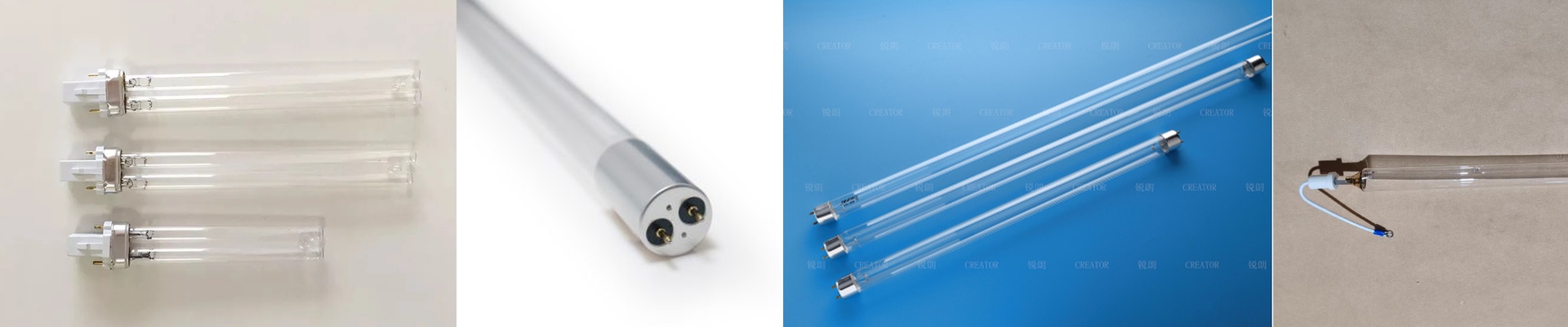


On a textile line, a lamp that wanders in spectral output doesn’t just drag out cure—it gives you inconsistent hand-feel, weak wash fastness, and a pile of rework. Mercury UV lamps for textile printing have to deliver stable, repeatable energy so the photoinitiators can cross-link properly across pigmented inks and coatings. And that reliability is decided long before the lamp ever hits your machine.
What matters, technically
We spec high-pressure mercury vapor lamps with real muscle around 365 nm, plus broad UVA coverage, to line up with the absorption profile of the photoinitiators most textile inks are built around. Power density and peak irradiance translate straight into cure speed: crank up the irradiance, shorten the exposure, and you can run faster roll-to-roll without cooking the ink. Reflector geometry and dichroic coatings are tuned to put more usable UV on the substrate and keep wasted heat out of the equation.
Why we do it this way
Every lamp we ship gets a full two-hour burn-in at full power on a calibrated test fixture. It’s 100% inspection, and it catches early-life instability while the arc settles, so what you install behaves predictably from the first cycle. The payoff is repeatable cure energy, fewer pinholes and adhesion failures, and a scrap rate that stays low on press. You also get consistent lamp-to-lamp spectral output, which matters when you swap lamps mid-run and need the same cure profile to carry over without tweaking everything.
The practical details you can’t skip
Match lamp power and arc length to the printer’s cure station design. If the reflectors are mismatched or the ballast is undersized, irradiance flattens out and cure time stretches. Mercury lamps are picky about orientation and cooling airflow—run them outside the rated envelope and output falls off fast. And expect end-of-life behavior: output drops and warm-up takes longer. Plan replacements around accumulated energy, not calendar time, and always confirm cure with a radiometer.